Search visibility has changed dramatically over the past few years. In 2026, small businesses are no longer competing only with local rivals or industry giants—they are competing with AI-generated answers, personalized search experiences, voice-driven discovery, and rapidly shifting consumer expectations.
For many entrepreneurs, the challenge is no longer understanding whether SEO matters. That debate is over. The real question is which SEO tools actually deserve attention, budget, and daily use.
A local service company, an online retailer, or even a niche consultancy can now outperform larger competitors if they use the right SEO tools strategically. But with hundreds of platforms promising instant rankings and automated growth, small businesses often end up overwhelmed by features they never use.
The smartest businesses in 2026 are taking a different approach. Instead of chasing “all-in-one miracles,” they are choosing SEO tools based on practical outcomes: visibility, leads, conversions, and operational efficiency.
This shift is especially visible across digital-first industries and local business ecosystems like those featured on business and money platforms, where discoverability increasingly defines commercial success.
The Role of SEO Tools Has Evolved Beyond Rankings
Traditional SEO once revolved around keyword density, backlinks, and ranking reports. Those metrics still matter, but modern SEO software now serves a broader purpose.


Today’s tools help businesses understand customer intent, monitor competitors in real time, automate technical improvements, optimize local visibility, and even generate content recommendations using AI.
What makes 2026 different is the speed of decision-making. Search trends now evolve weekly rather than quarterly. Businesses that react quickly gain momentum, while slower competitors disappear beneath AI-generated search summaries and featured results.
This is why SEO tools have become operational tools rather than marketing accessories. They influence product pages, customer acquisition, content strategy, user experience, and local reputation management.
Why Small Businesses Need SEO Tools More Than Enterprises
Large corporations can absorb inefficiencies. Small businesses cannot.
Every marketing dollar has to produce measurable returns, which is why modern SEO software is particularly valuable for smaller companies with lean teams and limited advertising budgets.
Instead of hiring multiple specialists, a business owner can now use integrated SEO platforms to:
- Track search performance
- Identify ranking opportunities
- Audit website health
- Optimize local search listings
- Analyze competitors
- Monitor customer behavior
For example, companies operating in highly competitive regional sectors—similar to businesses listed in Dubai business directories—often rely on SEO visibility to generate inbound leads without excessive paid advertising costs.
In practical terms, SEO tools reduce guesswork. They help businesses make decisions based on search demand rather than assumptions.
The Features That Actually Matter in 2026
Many platforms advertise hundreds of features, but only a handful consistently drive meaningful results for small businesses.
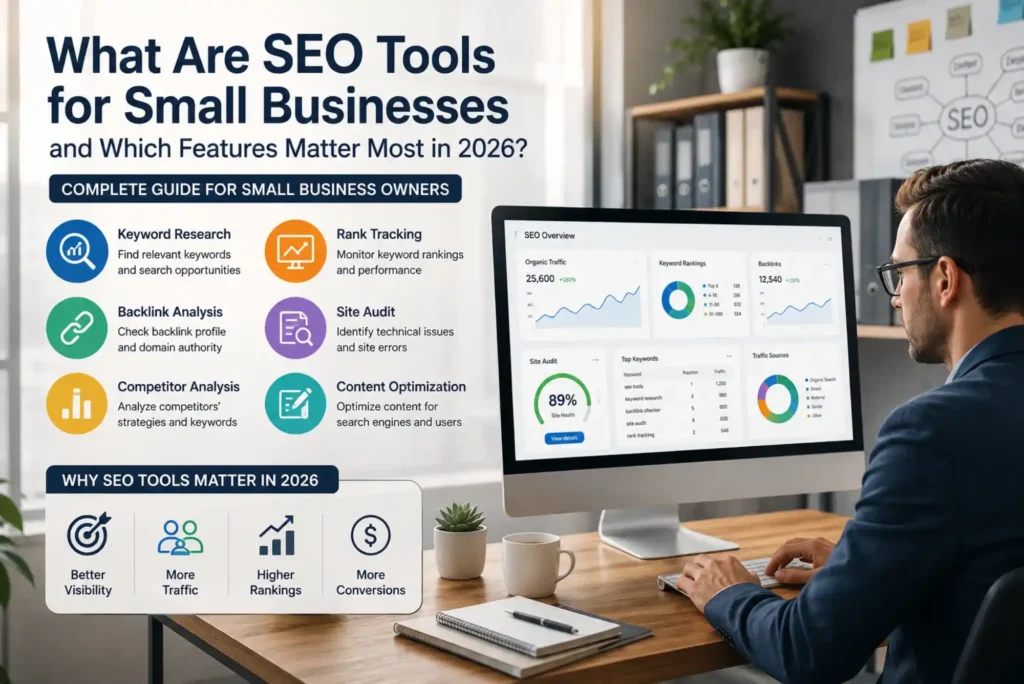
AI-Powered Keyword Intelligence
Keyword research has become significantly more sophisticated.
In 2026, successful SEO tools no longer provide simple search volume numbers. Instead, they analyze intent patterns, predict seasonal demand shifts, and identify conversational search phrases used in AI-assisted search environments.
This matters because search engines increasingly prioritize context over exact-match keywords.
Modern keyword tools can now reveal:
- Purchase intent signals
- Question-based search behavior
- Local search modifiers
- Voice-search phrasing
- Emerging low-competition topics
Businesses using these insights can create content aligned with real customer journeys instead of outdated SEO formulas.
Technical SEO Automation
Technical SEO used to require developers and specialized consultants. Today, many tools automate the most critical processes.
Platforms now automatically detect:
Broken links, indexing problems, duplicate content, slow-loading pages, schema errors, mobile usability issues, and crawl inefficiencies.
More importantly, advanced tools explain how to fix those issues in plain language.
This democratization of technical SEO has become essential because Google’s search systems increasingly prioritize user experience metrics. According to Google’s SEO Starter Guide, technical accessibility remains a foundational ranking factor.
Local SEO Capabilities
For small businesses serving specific geographic regions, local SEO is no longer optional.
Consumers increasingly search using phrases like “near me,” “open now,” and hyper-local service queries. SEO tools that specialize in local optimization can significantly improve visibility in map packs and localized search results.
The most effective local SEO features now include:
- Google Business Profile monitoring
- Local citation tracking
- Review management
- Geo-targeted keyword analysis
- Competitor map visibility tracking
This is especially important for service-oriented industries such as logistics, hospitality, healthcare, retail, and contracting services.
Competitor Intelligence
One of the biggest advantages modern SEO tools provide is transparency into competitor strategies.
Small businesses can now analyze:
Which keywords competitors rank for, which pages generate traffic, where backlinks originate, and what type of content performs best in their market.
This capability shortens the learning curve dramatically.
Instead of building SEO campaigns from scratch, businesses can identify proven opportunities and adapt them strategically.
In highly saturated sectors, competitor analysis often reveals content gaps that can generate quick ranking wins.
Content Optimization and AI Assistance
AI-generated content flooded the internet between 2023 and 2025. By 2026, search engines have become far more selective about quality, originality, and authority.
As a result, the best SEO tools now focus less on automated article production and more on intelligent content optimization.
Modern platforms help businesses:
- Structure articles for readability
- Improve topical depth
- Optimize semantic relevance
- Identify missing subtopics
- Enhance engagement metrics
The goal is no longer simply publishing more content. It is publishing content that satisfies user intent better than competitors.
This trend aligns closely with Google’s emphasis on helpful, people-first content outlined through its search quality documentation.
The Rise of Predictive SEO
One of the most important developments in 2026 is predictive SEO.
Instead of only analyzing historical data, advanced tools now forecast potential ranking opportunities before they become competitive.
Using AI and behavioral trend analysis, predictive SEO tools can identify:
- Emerging search patterns
- Industry trend acceleration
- Rising customer interests
- Potential traffic spikes
- Declining keyword relevance
This creates a significant advantage for smaller businesses that can move faster than enterprise competitors.
Companies that adapt early often dominate niche search segments before larger brands react.
Why Simplicity Matters More Than Feature Volume
Ironically, many businesses fail with SEO tools because they choose overly complicated platforms.
In 2026, usability matters almost as much as functionality.
The best SEO software for small businesses is not necessarily the most advanced platform. It is the one teams can consistently use without requiring constant expert intervention.
A clear dashboard, actionable recommendations, and streamlined reporting often generate better outcomes than complex enterprise systems loaded with unnecessary modules.
This is especially true for growing businesses that need operational speed rather than excessive technical depth.
SEO Tools and the Integration Economy
Another major trend shaping SEO software is integration.
Businesses no longer operate through isolated platforms. SEO tools increasingly connect with:
- CRM systems
- Email marketing platforms
- Analytics dashboards
- E-commerce stores
- Social media scheduling tools
- Customer support software
This integration allows businesses to connect search performance directly to revenue generation.
For example, a company can now track which keywords generate actual customers rather than just traffic.
This shift from vanity metrics to commercial metrics is redefining SEO decision-making.
Businesses focused on sustainable digital growth—particularly those building authority through guest posting and content marketing—are increasingly prioritizing SEO ecosystems rather than standalone tools.
How Small Businesses Should Choose an SEO Tool in 2026
The best SEO platform depends less on popularity and more on operational fit.
Before selecting software, businesses should evaluate:
- Their primary growth objective
- The complexity of their website
- The size of their marketing team
- The importance of local SEO
- The need for automation
- Reporting and analytics requirements
For some businesses, a lightweight local SEO platform may outperform expensive enterprise suites. For others, AI-powered content intelligence may deliver the greatest competitive edge.
The smartest companies avoid paying for features they never use.
The Human Element Still Matters
Despite rapid advances in AI-driven SEO software, successful optimization still depends heavily on human judgment.
SEO tools provide data. Businesses provide strategy.
The most effective companies combine technology with strong editorial thinking, customer understanding, and authentic brand positioning.
Search engines are becoming increasingly sophisticated at detecting shallow, generic content. Businesses that rely entirely on automation often struggle to maintain long-term visibility.
In contrast, brands that use SEO tools to enhance human creativity rather than replace it tend to build stronger authority over time.
Conclusion
SEO tools for small businesses in 2026 are no longer just digital marketing accessories—they are growth infrastructure.
The right platform can uncover customer demand, improve search visibility, automate technical improvements, strengthen local discovery, and support smarter content strategies.
But the businesses seeing the strongest results are not necessarily using the most expensive tools. They are using the most relevant tools with clear strategic intent.
As search ecosystems continue evolving around AI, personalization, and intent-driven discovery, small businesses that invest in practical, adaptable SEO tools will be better positioned to compete, scale, and sustain online visibility in an increasingly crowded digital landscape.
FAQs
What are SEO tools for small businesses?
SEO tools are software platforms that help businesses improve search visibility through keyword research, technical optimization, analytics, competitor tracking, and content improvement.
Which SEO feature matters most in 2026?
AI-powered search intent analysis is becoming one of the most valuable features because search engines now prioritize contextual relevance and user satisfaction.
Are free SEO tools enough for small businesses?
Free tools can help with basic optimization, but growing businesses often need advanced analytics, automation, and competitor intelligence available in paid platforms.
Do local businesses need specialized SEO tools?
Yes. Businesses targeting specific regions benefit significantly from local SEO tools that manage maps, reviews, citations, and geo-targeted search visibility.
Can AI replace SEO professionals completely?
No. AI can automate analysis and recommendations, but human expertise remains essential for strategy, branding, storytelling, and audience understanding.
Related Reading: The Modern Laser Machine: A Complete Guide for Businesses and Creators — full guide