
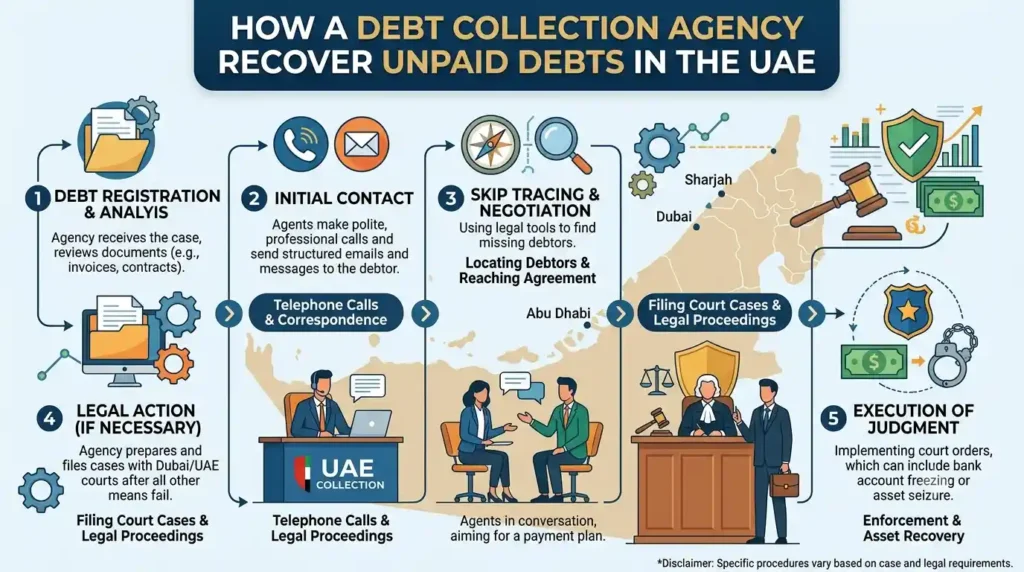
A Debt Collection Agency can help creditors recover
unpaid debts by communicating with debtors, reviewing account information,
negotiating repayment arrangements, issuing formal demands, and, where
appropriate, assisting with legal recovery proceedings. The exact process
depends on the nature of the debt, the agreement between the creditor and
debtor, and the applicable laws and procedures in the UAE.
Debt collection is not simply about repeatedly demanding
payment. A professional agency generally follows a structured process designed
to establish the debt, communicate with the debtor, seek voluntary payment, and
escalate the matter when necessary.
What Is a Debt Collection Agency?
A Debt Collection Agency is a business that assists
creditors with recovering money owed by individuals or companies.
A creditor may engage an agency when:
- Payments
have become overdue - Previous
payment requests have failed - The
debtor has stopped responding - The
creditor does not have an internal recovery department - The
creditor wants professional assistance with negotiations - The
debt involves a business or commercial relationship - Cross-border
recovery assistance is required
The agency generally acts on behalf of the creditor rather
than becoming the original owner of the debt, although the legal arrangement
can vary.


What Is the First Step in Debt Collection?
The first step is usually reviewing the debt and relevant
documentation. A Debt Collection Agency may examine contracts, invoices,
account statements, payment records, correspondence, and other evidence
provided by the creditor.
This review helps establish:
- Who
owes the money - Who is
claiming payment - The
original amount - Payments
already received - The
outstanding balance - When
the debt became due - Whether
supporting documents are available
A properly documented claim gives the agency a clearer basis
for communicating with the debtor.
How Does the Agency Contact the Debtor?
After reviewing the account, a Debt Collection Agency
may contact the debtor using appropriate communication channels.
Depending on the circumstances, communication can include:
- Telephone
calls - Emails
- Written
notices - Formal
payment demands - Other
appropriate correspondence
The communication should identify the nature of the claim
and provide sufficient information for the debtor to understand what is being
requested.
A professional agency should maintain records of its
communications and avoid misleading or abusive practices.
Can a Debt Collection Agency Negotiate a Payment Plan?
Yes. Negotiation is often an important part of debt
recovery.
A Debt Collection Agency may communicate with a
debtor to determine whether the debt can be resolved through:
- Full
payment - Installment
payments - A
negotiated settlement - Revised
payment dates - Another
mutually agreed arrangement
Any settlement or payment arrangement should be clearly
documented so that both parties understand the agreed terms.
What Happens If the Debtor Disputes the Debt?
If a debtor claims that the debt is incorrect, the agency
may need to review the dispute and supporting information.
The debtor might dispute:
- The
existence of the contract - The
amount claimed - Previous
payments - Interest
or charges - The
identity of the debtor - The
quality or delivery of goods or services - The
authority of the agency to collect
A Debt Collection Agency should distinguish between a
debtor who is simply refusing to pay and a debtor who has raised a genuine
dispute requiring further investigation.
Can a Debt Collection Agency Take Legal Action?
A collection agency’s ability to initiate or conduct legal
proceedings depends on its authority, the creditor’s instructions, the nature
of the debt, and applicable UAE procedures.
Where voluntary recovery efforts fail, the creditor may
consider formal legal action. A Debt Collection Agency may assist by
organizing documentation, communicating with legal representatives, and
supporting the recovery process.
Court proceedings should be handled through the appropriate
legal channels.
What Documents Does a Debt Collection Agency Need?
The documentation required depends on the debt. A creditor
may provide:
- Signed
contracts - Invoices
- Purchase
orders - Delivery
confirmations - Account
statements - Bank
records - Payment
receipts - Emails
and correspondence - Guarantees
- Settlement
agreements - Other
relevant records
A Debt Collection Agency can use these documents to
understand the claim and communicate more effectively with the debtor.
Can a Debt Collection Agency Recover Business Debts?
Yes. Debt collection agencies can assist with various
commercial debts, including amounts owed between businesses.
Commercial recovery may involve:
- Unpaid
invoices - Supplier
debts - Service
agreements - Trade
credit - Distribution
arrangements - Commercial
loans - Contractual
payment obligations
Business debt recovery can be more complicated when the
parties are located in different jurisdictions or when contractual disputes are
involved.
Can a Debt Collection Agency Recover Debts
Internationally?
Some agencies provide assistance with international debt
recovery. Cross-border cases can involve additional considerations because the
creditor, debtor, assets, and contractual obligations may be located in
different countries.
A Debt Collection Agency handling an international
claim may need to coordinate with lawyers, local recovery professionals, or
other authorized representatives in the relevant jurisdiction.
The applicable laws and enforcement procedures depend on the
country involved.
Is a Debt Collection Agency Allowed to Harass a Debtor?
No legitimate debt recovery process should be confused with
harassment or intimidation. The fact that money is owed does not give a Debt
Collection Agency unlimited freedom to use threatening, deceptive, or
abusive methods.
Debtors should distinguish between lawful collection efforts
and improper conduct.
If a collector makes false claims, uses serious threats,
improperly discloses confidential information, or engages in other potentially
unlawful conduct, the debtor may have grounds to raise a complaint or seek
legal advice.
Can a Debtor Ask for Proof of the Debt?
Yes, if there is uncertainty about the claim, the debtor can
request information identifying the debt and the creditor.
Depending on the circumstances, this may include:
- Creditor’s
name - Account
or reference number - Amount
allegedly outstanding - Relevant
contract - Payment
history - Supporting
invoices - Authority
to collect, where applicable
This is particularly important when the debtor does not
recognize the agency or the alleged debt.
How Long Does Debt Collection Take?
There is no universal timeframe. The duration depends on
factors such as:
- Amount
of the debt - Quality
of documentation - Debtor’s
willingness to cooperate - Whether
the debt is disputed - Whether
a payment plan is negotiated - Location
of the debtor - Whether
legal proceedings become necessary - Availability
of identifiable assets
A straightforward claim may be resolved relatively quickly,
while a disputed or cross-border debt can take considerably longer.
Can a Debt Collection Agency Recover a Debt Without Going
to Court?
Yes, many debts can potentially be resolved without
litigation. Negotiation and voluntary payment can be more efficient than formal
proceedings.
A Debt
Collection Agency may attempt to reach a settlement through
communication with the debtor before recommending or pursuing further legal
steps.
However, if the debtor refuses to pay or raises a
substantive dispute, court or other formal proceedings may become necessary.
What Should a Creditor Consider Before Hiring an Agency?
A creditor should evaluate the agency’s experience, documentation
procedures, communication practices, transparency concerning fees, and
experience with the type of debt involved.
It is also important to provide the agency with accurate
records. Incomplete or inconsistent documentation can make recovery more
difficult.
For significant claims, creditors may also wish to obtain
independent legal advice about available recovery options.
Conclusion
A Debt Collection
Agency can provide structured assistance in recovering unpaid debts in
the UAE. The process commonly begins with reviewing the debt and supporting
documents, followed by communication with the debtor, negotiation of payment,
and escalation to appropriate legal procedures where voluntary recovery does
not succeed.
The most effective approach depends on the circumstances of
each debt. Clear contracts, accurate financial records, professional
communication, and timely action can all improve the prospects of recovery.
Where a debt is disputed, substantial, or international, professional legal
guidance can help determine the most appropriate recovery strategy
Related Reading: How Annual Maintenance Contracts Help Prevent Business Downtime
Related Reading: How Smart Switch Manufacturers in China Meet the Demand of UAE Smart Cities — full guide
Related Reading: How to Not Get Stressed When Moving House — full guide
Related Reading: Pre-Nuptial Agreements and Wealth Protection in the UAE — full guide
Related Reading: Deck & Fence Staining in London, ON
Related Reading: EPD Consultancy firms in UAE — full guide
Related Reading: Affordable Refrigerator Fixing Sharjah