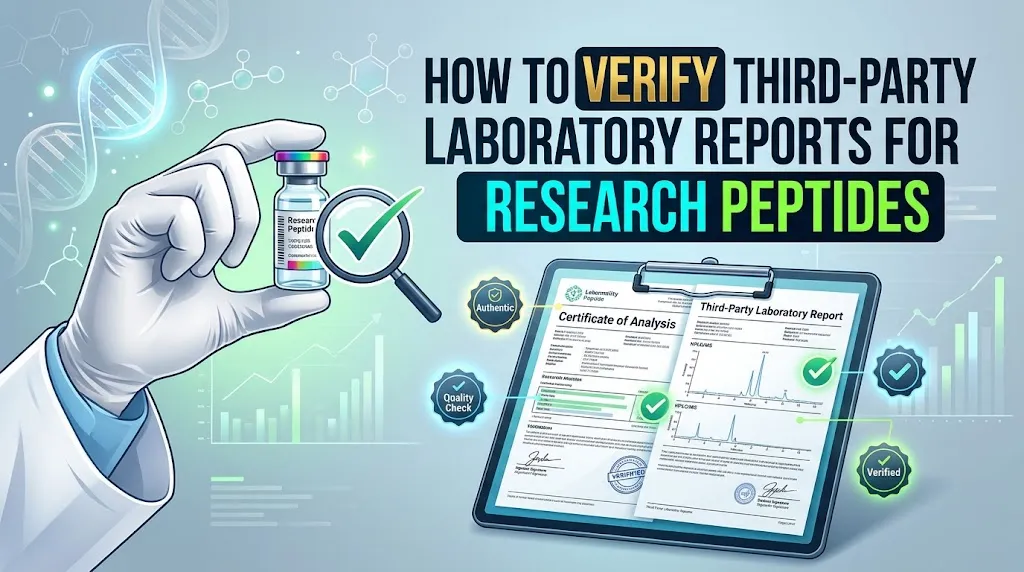
Third-party laboratory reports can provide useful analytical information about research peptide materials. However, simply receiving a PDF document or viewing a certificate image does not automatically establish that the report is authentic or that it relates to the product being reviewed.
Researchers should examine the issuing laboratory, report reference, sample identification, analytical methods, and available verification information.
For laboratories in the United Arab Emirates (UAE), these checks can support more consistent procurement records and help distinguish genuine analytical documentation from incomplete or unverified material.
Suppliers such as Remy Research publish selected third-party laboratory documentation for research-use-only materials.
This article explains how researchers can review and verify third-party reports while understanding the limitations of the available evidence.
1. What Is a Third-Party Laboratory Report?
A third-party laboratory report is an analytical document issued by a testing organization that examines a submitted sample.


Depending on the laboratory and testing arrangement, the report may contain information about:
- Sample identification.
- Client or submitting party.
- Report reference number.
- Testing laboratory.
- Analytical methods.
- Testing dates.
- Reported findings.
- Relevant notes or limitations.
Third-party testing can provide an additional source of analytical information beyond a supplier’s own product description.
However, the presence of a third-party laboratory name does not independently prove that a document is genuine. Its origin and supporting details should be examined.
2. Identify the Issuing Laboratory
The first step is to establish which laboratory issued the report.
Researchers should look for the laboratory’s full name and any available identifying information.
Useful details may include:
- Official laboratory name.
- Business or institutional identity.
- Contact information.
- Report reference.
- Address or location, where stated.
- Laboratory website, if provided.
If the report contains unclear or incomplete laboratory details, researchers should request clarification.
It is also important to distinguish the testing laboratory from the supplier or company that submitted the sample.
A supplier may arrange testing and publish the resulting report, but this does not make the supplier the issuing laboratory.
3. Check the Report Number and Sample Reference
A report number is an important identifier because it can help locate or confirm a particular analytical document.
Some laboratories also provide a separate sample identification number.
These references should be recorded accurately.
When reviewing a report, check:
Report Number: Does the document contain a unique reference?
Sample ID: Is the submitted sample identified?
Client Reference: Is the submitting organization named, where applicable?
Testing Date: Does the document identify when the analysis was performed?
Issue Date: Is the report publication or issue date available?
A report number should not be confused with a product batch number. They may refer to different identification systems.
4. Use the Laboratory’s Official Verification Process
Some laboratories provide online verification systems, while others rely on direct communication.
Where an online verification facility is available, researchers should use the laboratory’s official website rather than relying on an unrelated verification link supplied by an unknown source.
A typical review may involve:
- Locating the laboratory’s official verification facility.
- Entering the report number or verification reference.
- Comparing the retrieved document with the supplied copy.
- Checking sample identification.
- Reviewing the reported analytical findings.
- Recording any differences.
Not every laboratory provides online verification. In those cases, researchers may need to contact the issuing laboratory using independently confirmed contact information.
The verification process should match the laboratory’s actual procedures.
5. Compare the Verified Document with the Supplied Copy
When a laboratory provides an original or independently retrievable report, researchers should compare it with the document supplied by the seller.
The comparison should include:
- Laboratory name.
- Report number.
- Sample reference.
- Product or sample description.
- Testing date.
- Analytical methods.
- Reported results.
- Notes and qualifications.
Pay particular attention to missing pages, altered text, inconsistent sample references, and differences in reported findings.
A screenshot or cropped certificate image may omit important information.
Whenever possible, review the complete report rather than relying on selected sections.
6. Examine the Analytical Methods
Authenticity and analytical interpretation are separate questions.
Even when a report is genuine, researchers must understand what its tests actually establish.
For example, a report may include HPLC analysis, LC-MS screening, or other analytical procedures.
Each method has a different purpose and analytical scope.
Researchers should check:
HPLC
Review the chromatographic method, detector information, chromatogram, and calculation basis where available.
LC-MS
Examine the reported mass-to-charge information and any interpretation provided by the laboratory.
Additional Testing
If the report includes endotoxin, heavy-metal, residual-solvent, or other testing, review the specific method and reported units.
A report should never be described as confirming a characteristic that was not actually tested.
7. Understand What the Report Says About the Sample
One of the most important verification steps is understanding exactly which sample was examined.
A laboratory report applies to the sample identified in that document.
It does not automatically establish the characteristics of:
- Every product carrying the same compound name.
- Every available strength.
- Every product format.
- Every subsequent manufacturing batch.
- Every future shipment.
For example, a report may identify a particular vial sample, while a supplier also lists a pen format containing a similarly named material.
Unless the documentation establishes the relationship, researchers should not assume that the report directly tests both formats.
Supplier-provided sample mapping should be distinguished from direct testing of the mapped product.
8. Check Dates and Batch Relationships
The dates shown in a laboratory report help establish when the identified sample was received, analysed, or reported.
Researchers should compare these dates with the product documentation and available batch information.
Useful questions include:
- When was the sample received by the laboratory?
- When was the analysis performed?
- When was the report issued?
- Is a batch number provided?
- Does the report relate to the product currently being reviewed?
- Is the relationship between the tested sample and current inventory documented?
A historical report may remain useful as a record of the sample tested, but it should not automatically be presented as confirmation of a newer batch.
9. Recognise Incomplete or Unreliable Documentation
Certain issues may indicate that a report requires further investigation.
Examples include:
Missing Laboratory Identity
The document does not clearly identify the organization responsible for testing.
Unclear Sample Description
The tested material cannot be identified confidently.
Missing Report Reference
No report number or equivalent identification is available.
Incomplete Pages
Important sections, analytical findings, or laboratory notes are missing.
Inconsistent Information
Sample names, dates, or report references differ across documents without explanation.
Unsupported Claims
The supplier describes results beyond the scope of the actual analytical report.
These issues do not automatically establish that a report is fraudulent. They indicate that further clarification or verification may be necessary.
10. A Practical Third-Party Report Verification Checklist
Researchers can use the following checklist when reviewing laboratory documents.
| Verification Point | What to Examine |
| Laboratory identity | Full issuing laboratory name |
| Report reference | Unique report number |
| Sample identification | Sample name or ID |
| Batch information | Batch or lot reference, where available |
| Testing date | Date of analytical work |
| Issue date | Date the report was issued |
| Analytical methods | Methods actually performed |
| Reported results | Findings and units |
| Original document | Complete report rather than a cropped image |
| Verification route | Official online or direct laboratory confirmation |
| Sample relationship | Whether the report matches the product being reviewed |
| Limitations | Any qualifications or missing information |
Keeping a completed checklist with procurement records can help establish a consistent review process.
11. Why Transparent Documentation Matters in the UAE
Research organizations in the UAE may work with suppliers, manufacturers, and laboratories located in different countries.
Clear documentation can help maintain a traceable record of where information originated and which sample was tested.
When reviewing a supplier, researchers should consider:
- Whether the supplier identifies its business clearly.
- Whether product information is available.
- Whether analytical documents can be reviewed.
- Whether report references are provided.
- Whether batch relationships are explained.
- Whether limitations are communicated honestly.
Researchers can also review published Batch Documentation to understand how sample references and laboratory findings are presented for selected research materials.
The existence of published documentation should not be interpreted as proof that every product or batch has undergone the same third-party testing.
12. Maintain an Internal Verification Record
After reviewing a third-party report, laboratories should maintain a record of the verification process.
A simple internal record may include:
- Product name.
- Supplier name.
- Sample reference.
- Batch or lot number.
- Laboratory name.
- Report number.
- Testing date.
- Verification date.
- Verification method.
- Reviewer name or department.
- Any unresolved questions.
Where a report is verified through direct communication, laboratories may retain the relevant correspondence according to their internal record-management policies.
This approach makes it easier to revisit documentation and understand the basis of previous procurement decisions.
Conclusion
Third-party laboratory reports can provide useful analytical evidence about research peptide samples, but their value depends on accurate identification, authenticity, and appropriate interpretation.
Researchers should verify the issuing laboratory, examine report numbers, compare the supplied document with available original records, and confirm which sample was actually tested.
They should also distinguish between a genuine report and the broader claims a supplier may make about its products.
For UAE laboratories, maintaining a structured verification process can improve documentation quality and support more consistent research material records.
Research Use Only: Materials discussed in this article are intended strictly for in-vitro laboratory research only. They are not intended for human or veterinary use. Nothing in this article constitutes medical advice, diagnosis, treatment, or a recommendation for human or veterinary application.