
Introduction
Business operations depend on reliable equipment and properly functioning facilities. Whether a company operates an office, warehouse, retail store, hotel, factory, or commercial property, unexpected equipment failures can interrupt normal activities and create unnecessary expenses.
Downtime can affect productivity, customer satisfaction, employee performance, and business revenue. A malfunctioning air conditioning system, electrical failure, plumbing issue, machinery breakdown, or generator problem can quickly become a major operational challenge.
An Annual Maintenance Contract (AMC) provides businesses with a proactive approach to managing these risks. Through scheduled inspections, preventive servicing, and technical support, an AMC can help businesses reduce the likelihood and impact of unexpected equipment problems.
Understanding Business Downtime
Business downtime occurs when equipment, systems, or facilities are unavailable or unable to perform their intended functions.
The impact can range from minor inconvenience to significant operational disruption.
For example, employees may be unable to work effectively if essential office systems fail. A retail business may experience customer inconvenience if critical facilities stop functioning. In industrial environments, machinery failure can interrupt production.


The cost of downtime is therefore not limited to the repair bill. It can also involve lost productivity, delayed services, missed deadlines, and customer dissatisfaction.
Why Equipment Failures Cause Downtime
Equipment can fail for many reasons.
Normal wear and tear, poor maintenance, damaged components, overheating, electrical problems, improper use, and aging equipment can all contribute to unexpected failures.
Some problems develop gradually and show warning signs before complete failure occurs.
Without regular inspections, these warning signs may go unnoticed.
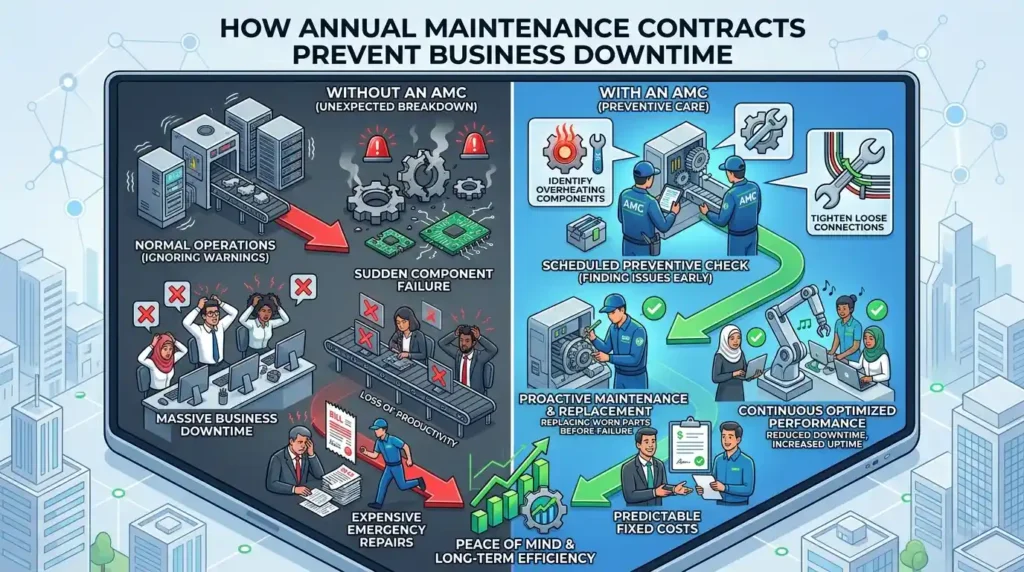
Preventive maintenance helps identify potential problems before they have a greater effect on business operations.
How an Annual Maintenance Contract Helps
An annual maintenance contract establishes a planned relationship between a business and maintenance provider.
The contract typically defines the equipment covered, maintenance schedule, service responsibilities, and response procedures.
Instead of waiting for equipment to fail, technicians perform scheduled inspections and maintenance.
This proactive approach can help reduce avoidable breakdowns and make maintenance activities more predictable.
Regular Inspections Can Identify Early Warning Signs
Regular inspections are an important part of reducing downtime.
Technicians can examine equipment for unusual sounds, leaks, overheating, vibration, damaged components, loose connections, reduced performance, and other warning signs.
Identifying these problems early allows businesses to address them before they become major failures.
Early intervention may require less time and fewer resources than repairing a system after complete breakdown.
Preventive Servicing Reduces Failure Risks
Preventive maintenance involves performing service activities before equipment develops serious problems.
Depending on the system, preventive servicing can include cleaning, lubrication, filter replacement, testing, adjustments, and component inspections.
An AMC creates a schedule for these activities, helping businesses maintain equipment consistently.
Regular servicing can support more reliable equipment performance and reduce problems associated with neglected maintenance.
Faster Response to Maintenance Problems
Even with preventive maintenance, unexpected problems can still occur.
An AMC can provide businesses with an established maintenance provider to contact when an issue arises.
Depending on the contract, the provider may offer defined response times or priority service.
Having an established service relationship can make it easier to arrange technical support compared with searching for a new provider whenever a problem occurs.
Reduce Emergency Repair Delays
When a business relies entirely on emergency maintenance, there can be delays in finding an available technician.
This can increase the duration of downtime.
With an annual maintenance contract, the business already has an established maintenance relationship.
The provider is familiar with the equipment and maintenance history, which can help technicians understand the situation more efficiently.
Improve Equipment Reliability
Equipment reliability is closely connected to business continuity.
Regular maintenance helps identify issues that may affect performance and allows technicians to address them before they become serious.
An AMC supports this process through scheduled service visits and ongoing equipment monitoring.
Reliable equipment can help businesses maintain more consistent operations and reduce avoidable interruptions.
Protect Critical Business Systems
Some systems are more important to business operations than others.
For example, a production machine may be essential to a factory, while cooling systems may be critical in certain commercial environments.
Businesses should identify their most critical equipment and ensure that maintenance plans provide appropriate coverage.
An AMC can be customized to prioritize important systems based on operational requirements.
Reduce the Impact of Maintenance Activities
Maintenance itself can sometimes cause temporary disruption.
However, planned maintenance can be scheduled during suitable periods to minimize its effect on business operations.
Businesses can coordinate service visits around working hours, production schedules, or periods of lower activity.
This is another advantage of planned maintenance compared with unexpected emergency repairs.
Maintenance Records Support Better Decisions
Maintenance records provide valuable information about equipment condition.
Service reports can show when equipment was inspected, what problems were identified, which repairs were completed, and what recommendations were made.
By reviewing these records, businesses can identify recurring problems and determine whether equipment requires additional attention.
This information can support long-term decisions about repair, replacement, or upgrades.
Reduce Recurring Failures
Repeated equipment failures can be particularly disruptive.
If a business keeps repairing the same problem without identifying the underlying cause, downtime may continue to occur.
Regular maintenance allows technicians to monitor recurring issues and investigate their causes.
An AMC can therefore support a more systematic approach to resolving persistent equipment problems.
Support Business Continuity
Business continuity requires preparation for potential disruptions.
While an AMC cannot eliminate every equipment failure, it can reduce some of the risks associated with poor or delayed maintenance.
Regular servicing, equipment inspections, maintenance records, and established technical support can all contribute to better operational preparedness.
Businesses can also use maintenance information to identify critical assets that require additional protection.
Choosing an AMC Provider for Downtime Prevention
Not every maintenance provider offers the same level of support.
Businesses should evaluate technical expertise, response times, emergency availability, service coverage, technician qualifications, and previous experience.
The provider should understand the importance of minimizing downtime and have procedures for responding to urgent maintenance problems.
Contract terms should clearly define service responsibilities and response expectations.
What Should the Contract Include?
A suitable AMC should clearly identify the equipment and systems covered.
It should also explain the maintenance frequency, services provided, response times, emergency support, reporting procedures, exclusions, and additional charges.
Businesses should understand whether spare parts and major repairs are included or billed separately.
Clear terms help ensure that the maintenance strategy matches the actual needs of the business.
Final Thoughts
Business downtime can create significant operational and financial challenges. An Annual Maintenance Contract provides a proactive approach to reducing these risks through regular inspections, preventive servicing, planned maintenance, and professional technical support.
By identifying potential problems early, businesses can reduce the likelihood of unexpected failures and respond more efficiently when issues occur.
The effectiveness of an AMC depends on the quality of the maintenance provider and the coverage included in the contract. Businesses should therefore choose a reliable provider and carefully review all terms before signing.
A well-managed annual maintenance contract can help businesses maintain more reliable equipment, reduce avoidable downtime, and support smoother day-to-day operations.
Related Reading: How Does a Debt Collection Agency Recover Unpaid Debts in the UAE?
Related Reading: How to Not Get Stressed When Moving House — full guide
Related Reading: Pre-Nuptial Agreements and Wealth Protection in the UAE — full guide
Related Reading: Why Web Hosting Usa Matters for Your UAE Business Strategy
Related Reading: How Can Labour Lawyers Help Resolve Workplace Disputes in Dubai?
Related Reading: نشهد لحظة تاريخية لقطاع الألعاب في الخليج
Related Reading: EPD Consultancy firms in UAE — full guide